Showing posts with label Orfeo ed Euridice. Show all posts

Tuesday, 16 March 2021

Gluck - Orphée et Eurydice (Zurich, 2021)


Christoph Willibald Gluck - Orphée et Eurydice

Opera Zürich, 2021

Stefano Montanari, Christoph Marthaler, Nadezhda Karyazina, Chiara Skerath, Alice Duport-Percier, Sebastian Zuber, Graham F. Valentine, Bérengère Bodin, Marc Bodnar, Liliana Benini, Raphael Clamer, Bernhard Landau

Live Stream - 14th February 2021

There are some operas that seem to exist on another level, tapping into something indefinable and spiritual - Wagner's Tristan und Isolde or Parsifal, Stockhausen's Licht, Glass's Satyagraha, Mozart's Die Zauberflöte, Debussy's Pelléas et Mélisande - and many composers strive to reach that state through the power of music. Some of the best productions I have seen also strive to achieve that level of abstraction, not being held strictly to the exigencies of dramatic narrative, but finding a way in visual terms to tap into the same miraculous source that the music comes from.

One work that should certainly attain a level of transcendence beyond mortal matters is Gluck's Orfeo, or indeed in the French arrangement by Berlioz as Orphée et Eurydice. I presume that is also what director Christoph Marthaler is trying to do with his Zurich production, because it's hard otherwise to relate it to much that happens conventionally in any telling of the myth of Orpheus. Whether he actually achieves it is less certain, and indeed what he actually achieves is hard to define, but at the very least Marthaler attempts to bring an individual vision to a great opera.


There are essentially only three singers in Gluck's opera as well as a chorus, but it's more than enough to express everything that Gluck wanted to achieve in his stripped-back reformist version of opera. Really it couldn't be improved, although admittedly Berlioz's version, combining the best parts of Gluck's own Italian and French versions, is wonderful. What it doesn't need then is any additional figures or obscuring narrative imposed unless it can in some way support rather than distract from the beauty of the score and the intent of the original opera.

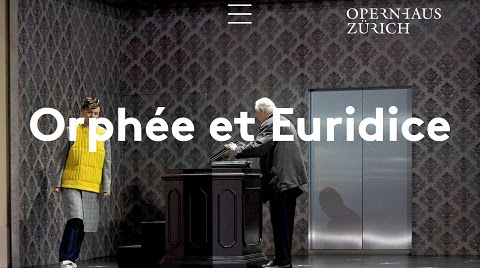
Christoph Marthaler puts several strange figures on the Zurich stage; a man like a caretaker or mortuary attendant (he has that mortuary pallor) shares a space in some indeterminate and likely otherworldly plane of existence with a number of other figures, one of whom - dressed in an ill-fitting bright woolen yellow tank top - we soon discover is Orpheus. The man, after scolding a loudspeaker that a young schoolgirl invisible to him has brought onto the stage for being mysterious, then paces though the rooms passing a funeral urn to shady figures who walk from room to room, into the lift and back again, each exchanging the urn and keeping it out of the reach of Orpheus. Meanwhile another figure makes jerky dance movements as if having a seizure.

What on earth (or heaven, or hell) this has to do with Gluck's opera is anyone's guess, but since the opening scene is Orpheus's lament for the death of Eurydice, we must presume (and it does fit in a way) that we are seeing an expression of the mind-state of Orpheus in a condition of deep bereavement, himself trapped in death's waiting room. I did say anyone's guess and that's mine. A beatific smile/stupid grin appears on the faces of these actors and dancers when one of the figures/abstractions turns out to be Amore/Love, offering Orpheus a way out of the prison of his disturbed state of mind. He has a few more horrors (interruptions, interventions and strange situations with eccentric characters) to face up to first.

I recall that Marthaler did something similar with his 2009 Bayreuth Tristan und Isolde, setting each of the acts on three levels of a descending room (or figures ascending?) as a way of putting them into an emotional space rather than a physical one. It's frankly a bit bonkers and you can hardly say that it's respectful of the work, but respect is overrated and works shouldn't be sacrosanct, not even Orphée et Eurydice. Whether it just throws random ideas out - lost arias, a recital of T.S. Elliott's 'The Hollow Men', pizzas all around - or whether it finds something new to express through the music and the meaning is up to the individual to interpret. Personally, I thought it entertainingly idiosyncratic and intriguingly unresolved, but far from the most spiritual or enlightening of productions.

Whatever you think about Marthaler's contribution, it's still Gluck's Orphée et Eurydice, which means it's still a work of exquisite beauty and delicacy. With its subject of grief, bereavement and the search for peace of mind and for the belief that love can win though times of social distancing and isolation, it's also a work that can have meaning at any time and make a personal connection, not least in these Covid-19 times. Marthaler of course doesn't directly reference the current pandemic, but there's no need to either: the very fact that this production of the opera is even able to take place at all is testament to the power of music and art to soothe and heal the soul in difficult times.

Zurich evidently have to make adjustments in order to put on a live opera performance in February 2021. There are some compromises that have to be made, the orchestra in a separate location, the chorus in another, with even the audience watching it distantly all around the world from a screen, so some disconnect is to be expected. Personally, I didn't find the music as beautiful, soothing and touching as it should be under Stefano Montanari, feeling somewhat disconnected from the stage performance. Whether that's down to the direction, the conducting or the difficulties of performance under current circumstances and blending the elements together is hard to determine, but like the recent Pelléas et Mélisande in Geneva, it feels like there is some vital element missing.

Although the recording and mixing of the live performance in an empty theatre makes it sound a little echoing, it's always a delight nonetheless to hear this work and see its themes explored and challenged. Although it seems like there are more people involved, there are indeed only three singers who carry the whole tormented character of the work and they do so well. Mezzo-soprano Nadezhda Karyazina is a rich lyrical Orpheus, but whether the unusual production played a part in it, I didn't get any sense of real feeling here. Chiara Skerath is not quite so strong vocally, but carried the haunted agnonised aspect of Eurydice better. Musically, I just didn't get the feeling from this that you ought to, and much as I enjoyed Marthaler's eccentric approach, the production didn't really work for me either.

Links: Opernhaus Zurich

Wednesday, 6 March 2019

Gluck - Orfeo ed Euridice (Dún Laoghaire, 2019)


Christoph Willibald Gluck - Orfeo ed Euridice

Irish National Opera, 2019

Peter Whelan, Emma Martin, Sharon Carty, Sarah Power, Emma Nash, Dominica Williams, Fearghal Curtis, Matthew Mannion, Robyn Byrne, Stefaniw Dufresne, Javier Ferrer, Sophia Preidel

The Pavilion Theatre, Dún Laoghaire - 28 February 2019


The absolute wonder of Gluck's Orfeo ed Euridice, the reason for its reputation as one of the greatest works of opera ever composed and the ability of the work to deeply move audiences some 350 years after it was composed, lies undoubtedly in its simplicity. Or rather its apparent simplicity since it relates to deep human feelings that connect us to myth, Gluck's work fully employing all the artistic musical, theatrical and dance elements that are the essence of opera. Refinement rather than simplicity of all those elements and how they work together was at the heart of Gluck's reformist agenda for opera, and it's in adherence to those principals that the Irish National Opera succeed in their beautifully simple but refined production.

Such indeed is the refinement and unadorned beauty of Orfeo ed Euridice and the deeper sentiments that underlie its purpose, that it can sustain all manner of interpretations. It is mythology after all. At the heart of the work is perhaps the rawest and most relatable of human emotions, those connected to love and loss, Orpheus's desire to bring his beloved wife Eurydice back from the dead practically serving as a model for Kübler-Ross's five stages of grief; denial, anger, bargaining, depression and acceptance. Gluck's ability to make those sentiments behind Orpheus's dramatic/symbolic journey vividly real in musical terms lie at the heart of the work.


Unquestionably then, even though La Fura dels Baus have successfully been let loose on the work with their enhanced stage techniques, they recognised nonetheless that it was essential to forge a connection between the music/musicians and the drama. In rather more stripped back conditions, while still presenting a theatrical presentation of extraordinary beauty, director and choreographer Emma Martin likewise, but through entirely different means, succeeds in making the essence of Gluck's timeless musical moods and melodies visible on the stage in the Irish National Opera's production.


First performed last year for the Galway Festival, but taken this year on a wider provincial tour of Ireland, the venues chosen remain (for the most part) small scale, permitting an intimate closeness with the drama and the production. Indeed, my front row seat at the Pavilion Theatre in Dún Laoghaire placed me practically in the 'orchestra pit', sharing a ground level space almost between the orchestra ensemble and 'stage'. Immersive theatre is nothing new, nor indeed is immersive opera, but it's quite another thing to be immersed in the same space that Gluck's Orfeo ed Euridice occupies, particularly one that in every other way strives to make the work's every sentiment tangible.

Stripping back the orchestra to its essential components, Peter Whelan's arrangement and conducting of the Irish Baroque Orchestra permits the beauty of each of the instruments and the part they play in each of the scenes to stand out all the more vividly. Emma Martin's production likewise reduces the vocal ensemble down to the main roles of Orpheus, Eurydice and Amore, with Amore also part of the four-way harmonised voices of the chorus for the Mourners, Furies and Blessed Spirits. Nothing was lost with this reduction, but rather the refinement of Gluck's musical scoring only even more apparent.

Orfeo ed Euridice was of course originally intended to make use of another element of opera that in the subsequent century after its writing tended to not have such a prominent role, and that's dance. Orfeo ed Euridice is written for movement, it's not the static stand-and-sing solitary aria expressions of the requisite numbers and sentiments of baroque opera, nor is it the stop-start division of singing and ballet of the French tragedie-lyrique, but an essential integration of dance into the whole flow and pace of the work. Orfeo ed Euridice indeed has been staged purely as a dance work, but more often opera productions tend to cut the instrumental/dance passages to suit modern tastes.


As a choreographer Emma Martin however knows the value of dance in Orfeo ed Eurydice adding another dimension to the opera and bring those sentiments to life. The INO production accordingly has a four-person troupe of dancers that symmetrically balance and in a way supplement the four-part chorus, flowing and weaving thought the work like the notes of Gluck's score brought to life. They vividly express all those stages of Orpheus's grief, as much as the impassioned singing of
Sharon Carty's Orpheus himself/herself; the anger and the struggle with the Furies (even transforming into a horrifying multi-limbed creature that stalks Orpheus across the stage, wrapping him in his submission to the Blessed Spirits, standing as a barrier between this world and the unreachable other.

The superb flow and choreography extends its mood and reaches outward to take in the stage itself. It doesn't need much in the way of set dressing but everything is purposefully employed, the lighting effective for the mood, the drapes at the back of the stage and the veils wrapped around the figures drawing everything together. It's not just the choreography or even the impressive technical blocking of the singers with the dancers and the sets, it's the direction of every scene to match and express those deeper human sentiments at the heart of the work.

The qualities of the human voice are essential to that purpose and Sharon Carty (Orpheus), Sarah Power (Eurydice) and Emma Nash (Amore) made them soar with love, anger, fear and regret. The essential moral of the mythological take, which was unfortunately lost under the stage requirement of the period to present a happier ending, must also be taken into consideration. Romeo Castellucci managed to address that brilliantly in his living-death element to his production for La Monnaie, and Emma Martin also takes the reality of the nature of bereavement into account here, consigning the happy ending to a kind of postlude that reminds us that after loss, life still goes on.


Links: Irish National Opera

Wednesday, 28 November 2018

Gluck - Orphée et Eurydice (Paris, 2018)


Christoph Willibald Gluck - Orphée et Eurydice

Opéra Comique, Paris - 2018

Raphaël Pichon, Aurélien Bory, Marianne Crebassa, Hélène Gilmette, Lea Desandre

ARTE Concert - October 2018

Gluck's original Italian version of Orfeo ed Euridice may already be considered as close to perfection as an opera can get, but you can't really argue that Hector Berlioz's version of the work doesn't respect and have equal value to the original. Well, you could argue the point that it doesn't entirely respect the reformist instrumental minimalism and that it includes a little ornamentation and extensions to suit the taste of a 19th century French audience, but by and large Orphée et Eurydice retains the essential quality of the music being entirely in service to the drama.

You know that because every scene and every note in Gluck's opera is necessary, heartfelt and powerful in conveying the meaning of the work, and the subjects it deals with are the deepest and most heartfelt of human emotions - love, loss, grief and redemption. Although in the latter case, even Gluck might have compromised the qualities of truth for the sake of narrative requirements and audience expectations, even if it remains a work of supreme beauty. Working with Berlioz's 1859 version, Raphaël Pichon attempts his own slight corrective to the 'happy' ending for the Opéra Comique's production, but the purity of Gluck's intentions remain even in their absence.


Directed by Aurélien Bory, the Paris production adheres to those basic principles in Gluck's musical composition and in how best to express the sentiments that lie behind the work in terms of the stage production that achieves maximum impact from minimal means. Berlioz's extended overture permits a way of showing Orpheus's loss of Eurydice, a simple large mirror over the stage giving an overview of the horror of her death. Eurydice falls to the ground, a hole opens up in the stage, a grave, and Eurydice is sucked down into it, the whole backdrop of Orpheus's world dragged down along with her.

The mirror also works effective for the appearance of Amore to inhabit the real world and also be representative of the metaphorical meaning of her presence. Borne aloft by dancing figures dressed in black, she appears in the mirror to float above the stage, achieving maximum impact with minimal means. Another effective use of stage craft is used to represent the Furies as dancers who are appeased by Orpheus, marking his descent into the underworld.

There's nothing old-fashioned in the costume designs, but nothing obtrusively modern about them either, the work inhabiting the same timeless place as the sentiments it is principally concerned with. With his smart suit and clicked back white hair, Orpheus looks less like a businessman and more like a music impresario, and it's in the voice, the musical qualities of that voice, that Orpheus embodies and expresses those qualities that represent humanity in its purest state, vulnerable and yet capable of striving to overcome adversity.


Musically at least, Raphaël Pichon brings out the beauty of this in Gluck's score, even if Berlioz's instrumentation doesn't quite pack the same edge and directness as it would on Gluck's period instruments. A contralto or mezzo-soprano however can bring great range to Orpheus in the Berlioz edition and Marianne Crebassa has tenderness and depth of expression in Orpheus's song of grief. There's a similar purity of expression that is appropriate for Eurydice and Amore in the singing of Hélène Gilmette and Lea Desandre, the overall impact that this gives to the work just breathtaking.

I'm less convinced that you can get away with correcting the limitations imposed on Gluck to provide a happy ending by simply cutting Amore's gift of returning Eurydice to life. I think that this is something that can be redeemed creatively to some extent in the stage directions, as Romeo Castellucci inventively managed in his production of Orphée et Eurydice for La Monnaie, but ending it prematurely by cutting the final scenes just leaves the opera feeling incomplete. Still, the acceptance of loss and bearing grief is perhaps closer to the truth for everyone, and Gluck certainly provides the necessary sombre reflection in that music that still makes for a thoughtful conclusion in this Opéra Comique production.

Links: Opéra Comique, ARTE Concert

Sunday, 9 September 2018

Gluck - Orfeo ed Euridice (Budapest, 2018)


Christoph Willibald Gluck - Orfeo ed Euridice

NorrlandsOperan, Armel Opera Festival 2018

Olof Boman, Åsa Kalmér, Susanna Levonen, Henriikka Gröndahl, Jeanne Gérard

ARTE Concert - 1 July 2018

You can always find ways of bringing a conceptual or modern-day reworking to the Orpheus myth, but what is more important in any performance of Orfeo ed Euridice is that it responds to the beauty, purity and simplicity of Gluck's reformist agenda for opera. The fact that it can easily sustain both modern conceptual (Romeo Castellucci) and more elaborate theatricality (La Fura dels Baus) and that it even has the flexibility to cast Orfeo as a mezzo-soprano, countertenor or even a bass! (Lyon 2015) is testament not only to the robustness of the framework that supports the opera, but that the principles behind it are also enduring.

It's one of the key works of all opera, one that any composer can look back on and learn from, and many of them did. The same goes for any jaded opera-goer (does such a thing exist?) or even anyone who has over-indulged in Strauss, Puccini and Wagner and wants to return right back to the basics. Whether it's the original Italian version Orfeo ed Euridice, Gluck's even more austere stripped back French version Orphée et Eurydice or even Berlioz's edition of the best of both worlds, it's an opera of exquisite beauty that demonstrates what opera is capable of in its blending of music and drama, in its use of myth and in the Orpheus-like magic of breathing new life into it that performance can bring.

The most important aspect then, and it's one that the Swedish NorrlandsOperan company do very well in their production, is that most basic of opera requirements - bringing the drama and the music together perfectly to highlight its essential purpose. Orfeo ed Eurydice is a work that celebrates love and music in its mythological subject, but it also considers death, grief and new beginnings as a necessary part of human existence.


I don't know if you can find any conceptual reading within the NorrlandsOperan production, performed here at the 2018 Armel Opera Festival, but the tilted mirror looking down on the stage somehow opens up the space while at the same time closing it down. The idea of division is important in Orfeo ed Euridice, most evidently in the demarcation between the living and the dead, and this is as effective a way as any of making that idea visual and ever-present. The main difference or unique point of this particular production is that Orpheus is a woman as well as Eurydice.

It's common enough for a woman to sing the role of Orpheus, the role often better suited to the more robust mezzo-soprano voice than the lyrical countertenor (although both have their own distinct qualities), but in the NorrlandsOperan production there is no attempt to make Orpheus look like a man. There's no need to either and it's not just to a concession to modern notions of diversity in relationships. The perfect simplicity of Orfeo ed Euridice and the myth itself is that the idea of love doesn't need to be defined in male/female terms. It's a human experience common to everyone and a woman is quite capable as a man of feeling the same love, grief and feelings for a loved one that takes Orpheus to such depths and yet rise above them.

Sung by Susanna Levonen and brilliantly directed by Åsa Kalmér, the depth of those feelings are beautifully expressed and never more apparent than in the glorious scene where Orpheus finally discovers Eurydice in Elysium with the Blessed Spirits ('Torna, o bella'). For this scene, as elsewhere, the set is simply dressed, kept down to essentials. A snowy veil lifts away from the floor as the lovers are reunited, the ancient pillars that were standing in Thrace now fallen in the Underworld. It's as simple and effective as that, and as simple and effective as Gluck's wondrous scoring of the opera.


It's given a fine musical reading as well, Olof Boman conducting the Armel orchestra through a full account of the work that includes all the dance pieces. I can't say that the dancing is great, but it's good to have these pieces included, particularly in the epilogue scenes. The chorus - a vital character in this work - is outstanding. Henriikka Gröndahl's Eurydice gives her character an equal footing with Orpheus, which is something you don't always get. It's an impressive performance with purity and sincerity of expression that takes into consideration the extreme suffering and exquisite joy that humans are capable of experiencing. Sung by Jeanne Gérard, Amore also has an extended role to play as a punkish - or perhaps Puck-ish - figure in red who observes the journey of Orpheus and permits a breaking of the usual rules.

Links: Armel Opera Festival, ARTE Concert

Tuesday, 24 March 2015

Gluck - Orfeo ed Euridice (Lyon, 2015 - Lyon)

Christoph Willibald Gluck - Orfeo ed Euridice

Opéra de Lyon, 2015

Enrico Onofri, David Marton,
Victor von Halem, Christopher Ainslie, Elena Galitskaya

Lyon - 14 March 2015

 
For a work that was intended to be stripped-back of ornamentation according to Gluck's reformist agenda for opera seria, Orfeo ed Euridice is surprisingly amenable to elaboration and interpretation. Whether it has the full resources of La Fura dels Baus behind it, or Castellucci's reaching out beyond the myth to the reality, what matters most is that a production gives focus and emphasis to the all-important dramatic and emotional core of the work. I'm not sure that it matters then the new Lyon production takes a few liberties with a staging that fully supports Gluck's dramatic intentions, but it's in very unconventional territory in its musical choices and interpretation.

Like Castellucci's Orfeo, the key point to be addressed is the ending, which must be reconsidered if one is to convey the truth of the drama and the myth. The happy ending imposed on Gluck's opera isn't convincing and it actually goes against the intentions of the myth by showing that death isn't the end and that there is a possibility of second chances. What there should be is the possibility of reward and redemption for Orpheus or at least some sense of coming to terms with the bereavement of his beloved Eurydice, but it is only in his art, in his music, that he finds the ability to endure and come out stronger from the experience.


David Marton's production for Lyon, part of their 'Les Jardins Mystérieux' opera festival, attempts to address this issue without invalidating the orginal myth or how it plays out in Gluck's opera. As its starting point, it takes inspiration from Virgil and depicts Orpheus as an aged writer who has never recovered from the death of his wife. The house he was building for them remains unfinished, and sitting at his desk tapping at a typewriter, he pours his loss out into his writing (the text projected on-screen behind him derived from a work by Samuel Beckett), as he is haunted by visions of their wedding, her death and the impossibility of ever being able to recapture what has slipped from his grasp. In his tortured prose, the old man attempts to rewrite his idea of a perfect life as it might have been, but it is doomed to fail.

The production takes the very unusual step then of splitting the role of Orpheus into two - an old Orpheus, a writer, and the younger version of his memory who is seen in flashback. As such, the traditional story is played out in a way that bears little relation to the original. Orpheus's journey to the Underworld is one that is undertaken more in writing than in 'reality', the old writer trying to reclaim what he once almost had, still seeing himself as a young man. The idea of not looking back at Eurydice isn't adhered to then, but it's more a case that Eurydice, ever-youthful in death, recoils when she sees past the young image of Orpheus to the reality of him now as an old man. It's only when the old Orpheus himself dies at the end of this production that he is reunited in the afterlife, young again, with Eurydice, the couple sharing a domestic moment with Love (Amor), depicted here as five children.

It's all a bit confusing at first, but in theory the director's concept is sound, and the production does touch on the beautiful poignancy of the work - even more so with its twist on the ending - without betraying the intent of the original. Musically however, this is not how you might be accustomed to hearing Orfeo ed Euridice. Not only do we have two Orpheuses, but one is a bass and the other a countertenor. Scored for a countertenor or mezzo-soprano, I would never have imagined the role being sung by a bass, and I don't quite know musically how they managed to split the role between the extreme range of male voices, but somehow they do it, and it is surprisingly successful. As hinted above in the description of the drama, the role of Amor is also reworked as a small chorus of five boys. This is all very unusual and it can be initially very confusing.

These aren't the only musical liberties taken with the work for the sake of this twist in the dramatic presentation. The music is also slightly 'adapted', and it takes a little while to get used to the unfamiliar interpretation. In one scene, for example, a radio broadcast listened to by the old Orpheus plays a musical response in interplay with the orchestra in the pit. Is this just being clever, or is there a valid reason for it? It may be that memories are stirred by the music on the radio, sparking off a sequence that lies somewhere between memory and imagination - the Elysian fields scene and Dance of the Blessed Spirits, for example, taking the form of a wedding reception. There are likewise a few pauses in order to let some dramatic scene play out or for Orpheus to hammer some more on his typewriter, which is not entirely satisfactory either, breaking up the flow and rhythm of the piece.


On the other hand, Enrico Onofri's interpretation and the actual playing of the orchestra is just beautiful, the opera played with all the dances included, the work allowed to breathe freely in those heavenly melodies, some of the greatest music ever written. There's no rigid Baroque playing here, the music is allowed to be dramatically expressive, putting the solo clarinet player on-stage for relevant Orphic musical expression, and the chorus are just extraordinarily good, lifting those moments of intense dramatic feeling. Consideration in the conducting was given towards the lighter voices of Christopher Ainsley's countertenor and Elena Galitskaya's Eurydice, allowing the beauty of the voices to carry. Victor von Halem's resonant, lyrical Wagnerian bass needed no assistance, and it was simply amazing to hear Orpheus sung in this register.

As slightly troubling as it might have been to hear such sacrosanct material played around with in this way, and as confusing as it might have been dramatically, this was a brave gamble by Enrico Onofri, David Marton and the Opéra de Lyon. I'm not sure that the Lyon audience knew entirely what to make of it all. Victor von Halem rightly received the loudest applause for a touching and beautifully sung performance, even if it wasn't entirely what Gluck had in mind. The contribution of the production team on the other hand wasn't entirely appreciated by a small section of the audience, however it should have been clear that if the worked touched as deeply as it did, establishing the right tone as a contemplative Orfeo ed Euridice, a sad one but never sentimental, it's because of and not despite those unconventional production choices in the music and the staging.


Links: Opéra de Lyon

Friday, 15 August 2014

Gluck - Gluck 300 Years (Blu-ray)

Christoph Willibald Gluck - Gluck 300 Years

Alceste - Stuttgart, 2006
Constantinos Carydis, Jossi Wieler, Sergio Morabito, Catherine Naglestad, Donald Kaasch, Bernard Schneider, Catriona Smith, Johan Rydh, Michael Ebbecke

Iphigénie en Tauride - Zurich, 2001
William Christie, Claus Guth, Juliette Galstian, Rodney Gilfry, Deon van der Walt

Orfeo ed Euridice - Royal Opera House, 1991
Hartmut Haenchen, Harry Kupfer, Jochen Kowalski, Gillian Webster, Jeremy Budd

Arthaus Musik - Blu-ray

In terms of content, this release is a fine way to celebrate Gluck's 300th anniversary, collecting what are quite simply three of the greatest works of opera ever written. All three operas are key works of Gluck's reform period, the purest examples of the composer's intentions to reduce extravagant ornamentation and bring opera back to its fundamental purpose as a means of dramatic expression. As such they are all derived from classical Greek dramas, mythological in scope but human in sentiments, profound in their meaning and exquisite in their musical arrangements.

Each of the productions differs in terms of musical performance and stage interpretation, but all are faithful to Gluck's vision of the pure music-drama. Orfeo ed Euridice is performed in its original Italian version, Iphigénie en Tauride in its original French version, Alceste in the 1776 French revision. While the quality of the performances is indisputable, the fact that all three operas are contained on one single BD50 Blu-ray disc might give a clue that quality of the video transfers for this release is far from expected High Definition standards.

Alceste - Stuttgart, 2006
There are a few odd touches in the 2006 recording of Stuttgart's full French edition of Alceste (complete with the concluding six-movement orchestral suite by Gossec), but other than the 20th century setting - some kind of combination of funeral parlour, recording studio and meeting house - there's nothing too unusual attempted in Jossi Wieler and Sergio Morabito's production. There's something oratorio-like about Alceste's grand choruses and funeral marches, with individual dramatic expressions of grief, despair and prayers as Alceste sacrifices herself, Apollo having promised that the dying King Admeto will be spared if someone worthy takes his place. That all comes across exceptionally well here.


Despite the lack of typical dramatic action, all the human drama of Alceste is taken to the limits and wrapped up in the music and the singing. The work is given a magnificent account here in the Stuttgart production conducted by Constantinos Carydis, and the singing gives full expression to the trials of human life held to the cruel and unfathomable whim of the Gods. Catherine Naglestad gives a strong, unmannered performance of dramatic intensity as Alceste, Donald Kaasch is a dignified lyrical Admeto. The chorus work is sublime.  

Iphigénie en Tauride - Zurich, 2001
Musically pared back to its pure emotional core, it's debatable whether Iphigénie en Tauride requires any further stage elaboration, but Claus Guth highlights the psychological depth that underlies the trauma of the characters by picking up on the (pre-)Freudian undercurrents, expressing them in dreams where papier-mâché doubles continually re-enact their nightmares and drive their actions. It's evidently not going to be to everyone's taste, but it is an interesting and valid interpretation of the opera's content, and it does indeed bring out - or perhaps overstate - elements that otherwise might pass by unnoticed.


Under William Christie, the orchestration presents the work in a clear, bright, stripped-back arrangement. It's less full bodied than other recordings I have heard, sounding like a chamber orchestra here presumably using period instruments. Both Juliette Galstian as Iphigenia - restrained, clear and with beautiful diction - and Rodney Gilfry as Orestes, take advantage of the spacious arrangements and sing purely, emotively, without needing to dramatically overstate.

Orfeo ed Euridice - Royal Opera House, 1991
The Royal Opera House's 1991 production of Orfeo ed Euridice from 1991 still stands up pretty well musically and it manages to reveal the aching beauty of the opera, but there are some curious staging elements in Harry Kupfer's direction that never quite add up to a consistent concept. Although fully staged with attention to mood and situation, the chorus are lined-up in rows in an extended orchestra pit in formal dress, and the singers too on occasion lapse into concert performance mode with the music score open before them as if they are in some kind of mentally abstracted state. Doubles are used and Amor speaks to Orfeo through their young child. The dress is contemporary 1990s casual, Orpheus looking like a pub folk singer, but the journey through Hell after the death if Eurydice is no less real and dramatically intense in this version.


The best thing about the performance is the countertenor Orpheus of Jochen Kowalski. There's a beautiful clarity and strength to his voice that reaches those extremes of Orpheus' mental state with tremendous force of expression. Eurydice is passionately delivered by Gillian Webster and Amor is enchantingly sung by Jeremy Budd. Hartmut Haenchen conducts a well-balanced version of the original 1762 Italian version of Orfeo ed Eurydice.

There are some terrific performances here of these great Gluck masterpieces and I was looking forward to seeing them upgraded to HD, but the transfers on this Blu-ray are very disappointing. Basically, it appears that the old DVD masters have just been transferred across to HD format, with all three operas contained on a single BD50 disc. The image and sound are reasonably good, and certainly acceptable for Standard Definition presentation, but on a large screen or projected, none of these will meet High Definition requirements. The image is soft, the transfer exhibits and perhaps even enhances the familiar flaws found in old video transfers. Alceste and Iphigénie en Tauride are 16:9 widescreen, while Orfeo ed Eurydice is 4:3.  Each performance comes with English, French, German, Spanish and Italian subtitles.

You're actually at a slight disadvantage with the BD release. The DVD version of this collection is a box set that collects each of the operas as individually cased DVDs. For convenience or uniformity, the BD release has PCM stereo on all performances, dropping the Dolby Digital 5.1 mix of Iphigénie en Tauride. There is no chapter selection on the Blu-ray, just the option to choose which opera to view, and there is no pop-up menu functionality. You can however find chapter-listings for each of the productions in the enclosed booklet. In addition to the three operas on the Blu-ray there is a "bonus" in the form of an hour-long film "Winds of Change, Winds of Love" by Inger Aby, a dramatised meeting between Gluck and his student Salieri, where the elder master advises on how success in Paris is as capricious and unpredictable as the wind.

It's undoubtedly convenient to have all three operas gathered together on a single BD disc, and the performances of these three great works are all well worth having, but very disappointing that this is not a true High Definition release.

Friday, 1 August 2014

Gluck - Orfeo ed Euridice (Buxton Festival 2014 - Buxton)

Christoph Willibald Gluck - Orfeo ed Euridice

Buxton Festival, 2014

Stuart Stratford, Stephen Medcalf, Michael Chance, Barbara Bargnesi, Daisy Brown

Buxton Opera House - 25 July 2014

Start with a simple idea. That's always the best way to approach Gluck's Orfeo ed Euridice. It doesn't preclude attempting something more elaborate in the style of La Fura dels Baus when the setting demands it, but in a modest theatre the size of the Buxton Opera House it helps if the idea is simple, relevant and respectful of the reformist nature of the work. The subject of Orfeo ed Euridice is however universal and timeless, so it can withstand a little tweaking and Stephen Medcalf's production for the Buxton Festival manages to achieve all that very well, without being over-ambitious.

The idea is indeed a simple enough one. Orpheus is a singer, right? He's famed for his lyrical musicianship, so there's nothing out of the ordinary in him being depicted as a rock-star with adoring fans clamouring around him as he steps off the stage at the start of Buxton's Festival 2014 production of Gluck's opera. The sentiments are the same, the human sense of suffering and bereavement are no different, the pain expressed at the loss of his beloved wife Eurydice no more nor less deeply felt than by anyone else in the same position.

Despite the trappings of the rock-star and his chorus of adoring fans, there's an admirable simplicity, directness and pureness of purpose in the set design that suits the content here. The stage is mainly bare, the only real prop being five block letters of Orpheus' stage backdrop that spell out the name ORFEO. These are lowered onto the stage and used to form the gates to the Underworld that he must pass in order to recover Eurydice, they are moved around to act as obstacles and they are used as needed for platforms and seats for chorus and principals alike.


There doesn't appear to be any deeper subtext here, unless you consider Orpheus's grief and his efforts to defeat death self-absorbed and self-important, which clearly isn't the intention of the work. The use of the letters of his name could be seen as an inner struggle to come to terms with the death of Eurydice, but I wouldn't read that much into it. A little reshuffling is done to form the word AMORE at the end (obviously with some additional letters), which shows that the production knows where the true sentiments lie, but elsewhere there's no attempt to be clever with wordplay or anagrams.

The production remains faithful also to the intent if not the exact literal classical depictions of the creatures of the Underworld. The Furies, blocking Orpheus' way by rolling the bold neon-lit letters into a barrier, wear shabby clothes and are the kind of characters you wouldn't want to run into in a dark alley. They do actually mug Orpheus here, stealing his wallet and belongings, before letting him pass. The inhabitants of Elysium, by way of contrast, are chilled-out beach-bums wearing shorts and bikinis. I wasn't sure smoking would be a fitting activity in such a place, but maybe they were smoking something a little more "recreational". It might explain why they found their game of blind-man's bluff with the grief-stricken Orpheus so hilarious.


The setting and the directorial choices are unconventional then, but work fine and match the tone and the intention of the work. Musically and in terms of the singing however, the production didn't always come together as well as it should. It's always good to have a counter-tenor in the role of Orpheus. In terms of singing voices, I personally prefer the role to be taken by a mezzo-soprano, but there's always a better dynamic when Orpheus is visibly a man and Eurydice a woman. Audibly, it's a different matter, and it seems to be harder to match the right counter-tenor voice with the soprano. Michael Chance sounded a little alarming when he dropped to the lower end of the register in the more dramatic pronouncements, but his high end was strong and ringing. Barbara Bargnesi was a credibly intense Eurydice and sang well, but the two voices just didn't blend all that well.


That said, some of the most affecting moments in the production were the ones shared by Chance and Bargnesi as Orpheus and Eurydice. Their encounter in the Underworld had real impact for its significance, as did the scene where Eurydice fades away again in his arms. Elsewhere however, I just wasn't feeling it. The slow tempo of the musical arrangements might not have helped. Working with the original version of the work, Stuart Stratford played it brooding and moody and not just in the overture. The Dance of the Furies was deliberated and menacing, the Dance of the Divine Spirits somewhat blissed-out. When there wasn't much happening on the set in terms of stage directions, this seemed to create something of a disconnect between the music, the action and the singing.

Aside from personal preferences regarding the pacing and how it related to the action on the stage, the Northern Chamber Orchestra gave a fine performance of Gluck's beautiful score for the 1762 Italian original version of Orfeo ed Euridice. All the dances were included and were lovely to hear. They aren't always deemed necessary for inclusion and can contribute to a slowing down of the drama, particularly when - as here - there's no actual dancing as such. It was left to the Festival Chorus to mill around during such moments shifting letters and they did so reasonably well. They were certainly in fine voice here, as elsewhere throughout the 2014 Buxton Festival programme. Daisy Brown also impressed as a bright omnipresent Amore.

Tuesday, 22 July 2014

Gluck - Orphée et Eurydice (La Monnaie-De Munt, 2014 - Webcast)


Christoph Willibald Gluck - Orphée et Eurydice

La Monnaie-De Munt, 2014

Hervé Niquet, Romeo Castellucci, Stéphanie d'Oustrac, Sabine Devieilhe, Fanny Dupont

La Monnaie, Internet Streaming - June 2014

Orphée et Eurydice has the distinction not only of being one of the purest and most pared-back expressions of Gluck's reformist agenda, reducing extravagant ornamentation and bringing opera back to its strength as a dramatic artform, but it's exquisitely beautiful in its simplicity.  The intent of the work is carried principally through the expression of one singer and the music itself. And, even though it has an ancient mythological subject, Orphée et Eurydice is not some lofty expression of sentiments detached from everyday life, but it has something real and meaningful to communicate to its audience. To its credit, I've never seen a performance of the work - in any of its many forms - that was anything but deeply heartfelt and humanistic in its outlook, but Romeo Castellucci's extraordinary 2014 production for La Monnaie touches deeply on the themes in the work in a way that takes it to an entirely new level.

Dealing with gods, demigods and supernatural events, it's easy to forget that there is a real human element to grand mythological subjects. They are only myths because they speak for all of our suffering, our struggles to exist, live, find love and happiness. Using the story of Orpheus, who in his overwhelming grief for the death of his wife Eurydice travels to the Underworld to retrieve her, Gluck recognises that the Orpheus myth is all about love, loss and bereavement. Despite the beauty of the sentiment and the sincerity of his intentions, it of course proves impossible for Orpheus to bring his loved one back to life (notwithstanding the reworked happy ending in the opera version). Those sentiments can work perfectly well in the concise and expressive beauty of Gluck's score alone, but the dramatic expression on the stage is also a vital part of opera, and Castellucci finds an innovative way to reconnect the myth with the reality.


Like mythology, opera too must not be lofty and detached, but should be relatable on a human level. Having carried out extensive research into 'locked-in syndrome' Castellucci literally takes the opera beyond the stage of La Monnaie and out into the world, the production being broadcast live directly to a medical ward 14km outside Brussels where a young Belgian woman called Els lies in bed, completely paralysed. She's effectively dead to the world, beyond the reach of her husband and loved-ones, unable to move or communicate other than through the blinking of her eyes that allow her to painstakingly form words and sentences one letter at a time. At the same time as the music of Orpheus reaches out to her in her condition, Gluck's music reaches out to express Els/Eurydice's condition to the audience and give us some indication of how her family must feel about their loss.

How this is achieved in the production is, like Gluck's music, outwardly simple, but in reality very precise and sophisticated technical measures are used to present art as an expression of deeper truths. For almost the entirety of the performance, Stéphanie d'Oustrac sings the role of Orpheus on a dark bare stage with only a pseudo-microphone in front of her. To the right of the stage is what looks like a life-support system, although it has lights showing music volume-control levels, so it could represent a transmitter of sorts. While Orpheus sings of his loss, the captions on the screen behind the singer show English captions that have nothing to do with the libretto, but rather tell the story of Els, a 28 year-old woman who has been in a pseudocoma for the last 18 months, suffering complete paralysis but retaining full cognitive abilities after brainstem damage caused by a thrombosis. The audience are advised that the opera is being broadcast live to her at this moment.


There's evidently no direct correlation between the story of Els and the Orpheus myth, but the broad sense of losing a person, of them being present but beyond reach and unable to interact with the world outside is identical to how Orpheus, despite every effort to reach Eurydice, is unable to bring her back to life. The descent to the Underworld is in some respect mirrored in the blurred black-and-white footage on the screen that shows a journey towards the medical centre where this real-life Eurydice lies, arriving there as Orpheus finds Eurydice among the spirits of Elysium ("Cet asile aimable et tranquille"). As the on-stage Eurydice (Sabine Devieilhe) appears behind the mesh screen, we meet Els, lying in her bed, blinking but unmoving, a pair of headphones relaying the song of Orpheus direct from the opera house of La Monnaie.

Castellucci's direction is simple but daring and completely in touch with what the work is all about - human grief, battling against outrageous fortune - and relating it back to ordinary people who suffer terribly from everyday trials. Although there's nothing abstract about Gluck's music, it takes the drama away from mere theatricality to show how it fully explores and expresses these vital aspects of the human condition. Castellucci even takes into consideration the happy ending that Gluck was obliged to provide for the stage, showing an Eurydice revived and alive, but - reflecting Els' condition - remaining behind a veil, unable to fully return to the world. This works for the audience and for the intent of Gluck's music drama, making the story vividly real and deeply moving, but Castellucci's production goes beyond even this, telling us something about the power of music and opera to touch on aspects of our lives that other arts cannot reach.

One person who recognised the power of the work and who was instrumental in keeping this Baroque work alive through the 19th century and beyond, was Hector Berlioz. The French version is understandably more popular in French-speaking countries than Gluck's original Italian version, and if Berlioz's 1859 version is not the most "authentic" edition (Gluck wrote a "definitive" French version himself as well as the original Italian and even a German-language version), it at least brings together the best elements of Gluck's variations while retaining the purity of its expression. I have a particular fondness for the Berlioz version myself and this is a superb performance of the work conducted at La Monnaie by Hervé Niquet. It's played slightly faster than usual, the overture in particular a little rushed when it should be a more brooding, but the tone and expression of the work is all there.


It's also there in the singing, which is just as vital in a work with only three individual roles. The singing here is just outstanding, Stéphanie d'Oustrac one of the best mezzo-soprano singers I've heard singing Orpheus, and you could hardly expect to find a brighter or more colourful voice for Eurydice than Sabine Devieilhe, who continues to impress. Also worth mentioning are Fanny Dupont's sensitive and delicate Amour and the powerful work of the Chorus that also serves to establish that otherworldly character of Orphée et Eurydice. It's no coincidence that the Orpheus myth was frequently chosen as the subject for the very first works of opera almost 400 years ago, exploring as it does the power of music to take us to those kind of unreachable places. That myth found its purest expression in Gluck's opera, and Romeo Castellucci's remarkable production of it is one of the finest expressions of opera as both art and life.

Links: La Monnaie - De Munt, RTBF Musiq3

Friday, 23 May 2014

Gluck - Orfeo ed Euridice (Český Krumlov 2013 - Blu-ray)

Christoph Willibald Gluck - Orfeo ed Euridice

Český Krumlov Castle, 2013

Václav Luks, Ondřej Havelka, Bejun Mehta, Eva Liebau, Regula Mühlemann

Arthaus Musik - Blu-ray

They don't often put on opera in Český Krumlov Castle, which has one of the oldest working Baroque theatres in the world and is a UNESCO World Heritage site. The restoration of the theatre was celebrated in 2011 with a performance and subsequent DVD/BD release of Domenico Scarlatti's Dove è Amore è Gelosia. Hardly an important or great work, it was an entertaining opera buffa, more notable for its historical and rarity interest as the first work written to be performed in the original theatre, but it gained considerably from the authentic Baroque presentation in its original setting.

I don't know if Gluck has any historical connection with Český Krumlov castle, but in the 300th year of the composer's birth, it's a fine place to re-examine one of the most important works in the entire opera repertoire in hopefully a more authentic light. With Václav Luks conducting the period Collegium 1704 orchestra, a traditionally-informed stage production lit only by wax candles and countertenor Bejun Mehta as Orpheus, an alto-castrato role more often performed by a mezzo-soprano, this Orfeo ed Euridice is undoubtedly closer to the original than most other productions. There are however a few caveats that can be given about the nature of the film itself.


Primarily, this production of Orfeo ed Euridice is shot as a film rather than a concert, which does take away somewhat from the charm of seeing it performed in a Baroque theatre. It's not filmed in the traditional manner of a live theatre performance, but it is nonetheless clearly a live performance, shot in seven days over a number of takes, with perhaps a small amount of overdubs. That's fine, and it's a good account of the work that matches the stripped-back reformist nature of the work with a reduced period orchestra. The casting is also good with Bejun Mehta's sweet countertenor giving this Orpheus a suitably lyrical quality, Eva Liebau a strong Eurydice and Regula Mühlemann a bright Amore.

This works wonderfully when its performed in Act I on the stage of the Baroque theatre where Orpheus mourns the death of Eurydice who is laid out on a marble catafalque. It's old-style theatre, with painted forests to the wings and a sea at the back with old-fashioned pulley-operated rolling sea effects. Amore too descends in an authentically shaky manner on a mechanical cloud to give Orpheus a chance to bring his beloved back to the land of the living. Unfortunately, once Orpheus descends through the trapdoor to the Underworld, much of the remainder of the performance takes place in the wider setting of the backstage of the theatre and the castle caverns and - other than the Elysium scene - not on the stage at all.


The locations backstage and in the wings are at least well used in this respect, retaining the candlelight illuminations, giving the underworld a suitably eerie and otherworldly appearance. Even here, with wooden beams and stone staircases there are no anachronisms, although you would suspect that the Furies here might be familiar with the "zombie shuffle" choreography of Michael Jackson's 'Thriller' video. There are some clever touches like the play of shadows embracing and holding hands as Orpheus leads Eurydice out of the underworld that don't need to rely on special effects. The idea is nice, playing on the magic of the theatre experience and how it extends beyond the stage and takes on a life of its own, but I did find that the 'film' concept and editing distracted from the power of the work itself.

Musically however, it sounds wonderful, the theatre creating a natural acoustic reverb rather than an amplified sound. It's not the clean, precise HD audio you might be used to, but there's no big orchestra here and neither should there be. There is rather a harder edged gut string pluck and rhythm that isn't quite so smooth, and heard this way it does present the opera in a new light. The original 1762 Vienna edition of the work has however been cut back slightly with most of the ballets shortened or excised entirely. The Act III, Scene 3 dances, for example, are all missing here. I suspect that the decision was made for artistic reasons (Bejun Mehta is credited also as Artistic Advisor here), since they get in the way of the clear narrative flow that is needed more for the film than a stage production, but such cuts aren't unusual.


On Blu-ray, this looks very fine indeed. There's a slightly softer edge to the image on account of it being filmed by candlelight, but it's clear and detailed with lovely tones and textures. The audio mixes are PCM stereo and DTS HD-master Audio 5.0. The mix is bright but there's a pleasant naturalness to the sound. The balance between the voices and the orchestra is different in the two mixes, the surround track seeming to make more use of reverb and give prominence to the voices, while the stereo track is more direct and evenly balanced. There are no extras on the BD25 region-free disc, but the booklet gives some background on how the film was made and the history of the Baroque theatre. There's no synopsis provided, but the plot of Orfeo ed Euridice is simplicity itself. Subtitles are in Italian, English, German, French, Spanish and Korean.

Friday, 12 October 2012

Gluck - Orfeo ed Euridice


OrfeoChristoph Willibald Gluck - Orfeo ed Euridice
Festival Castell de Peralada, 2011
Gordon Nikolić, Carlus Padrissa, La Fura dels Baus, Anita Rachvelishvili, Maite Alberola, Auxiliadora Toledano, Aline Vincent
Unitel Classica - C-Major
As an avant-garde experimental theatre group, continually expanding their techniques using the modern technology available, La Fura dels Baus don’t exactly do opera in a way that is respectful of tradition. With modern works that are less than respectful of the opera tradition itself - Weill’s anti-opera Rise and Fall of the City of Mahagonny or Ligeti’s anti-antiopera Le Grand Macabre - this can be a good thing, but it’s more questionable when applied to the works of reformist composers who had very specific ideas and theories about the nature of opera as drama. With the grand works of Wagner, on the Ring cycle and even with something like Tristan und Isolde, there is perhaps more scope for a more ambitious conceptual approach, but can the extravagant modern techniques and projections employed by La Fura dels Baus really be appropriate to a work as intimate and intentionally stripped-back to basics as Gluck’s Orfeo ed Euridice?
Orfeo ed Euridice was indeed the first of Gluck’s reformist works, but it would only really be in its later French incarnation Orphée et Eurydice (alongside the composer’s other important French operas Alceste and Iphigenie en Tauride), that many of the mannerisms of the Baroque opera seria were dropped. Gradually, Gluck’s works would forego the use of the harpsichord, ballet music, mechanical stage effects, recitativo secco, extravagant aria da capo singing or indeed any decorative effects that didn’t serve the progression and meaning of the drama alone, but some of these elements still remain in this first version of Orfeo et Euridice, the Vienna version from 1762. Still, it would seem to go against the spirit of a work that only has three principal roles - and the majority of it sung by only one person - to stage it as extravagantly, colourfully and spectacularly as it’s done here, using every technological tool available - projections, computer generated lighting effects, singers hanging from cables above the stage - as well as making every effort to fill the ample outdoor stage of the Castell de Peralada not only with chorus and supernumeraries, but even putting the orchestra up there on the stage as well. This surely wasn’t what Gluck intended.
Well, that depends on whether what is up there on the stage enhances the work or detracts from it, and while Carlus Padrissa goes a little overboard on special effects - he’s rather too fond of hanging singers above the stage from cables for my liking - it seems to me (as someone who holds this work in its varied incarnations in very high regard as one of the greatest works in all of opera) that everything works nonetheless in perfect accord with the music, the singing and the dramatic intent of the original work. There’s no reason why spectacle and dramatic purpose can’t co-exist. While Cupid might swing down a cable to a position above the stage then (a stunt-double is used while Auxiliadora Toledano sings off-stage), it can be seen as appropriate to elevate the messenger of the gods above the mortals below. Perching Orpheus on top of Eurydice’s stone monument could also be seen as being a little over-the-top, but the use of the same block as a tombstone to chart his descent into Hades and his ascent out of it with Eurydice, is also a relatively simple but highly effective image. It’s in the depiction of the dark fiery landscapes of Hades, the assembled masses of Furies, shades and spectres, the serene beauty of the Elysian fields and the visions of the Blessed Spirits however that the director’s vision most impressively rises to the challenges in the score with some inventive techniques, projections and lighting effects that work hand-in-hand with what the music and the drama are telling us.
The orchestra, dressed in unflattering skin-tight body suits sitting in small individual pits on a stage that is tilted towards the audience, play their part in this too. Their position leaves only a diagonal space for the funeral procession of Eurydice in Act I, which makes it look like Padrissa is simply just trying to just fill the stage and keep it visually interesting, but they also get up and move around, playing at the same time, during Act II’s descent of Orpheus into Hades. It may not be what Gluck had in mind exactly when he set about making music serve a purely dramatic function, but one could argue that the music of Orpheus does indeed have a function in fending off the Furies, and highlighting that element in visual terms is a valid technique. It is at least not just some random concept that distracts from the meaning, but is clearly one that comes from paying close intention to the drama itself, and seeking to find the best way of illustrating it. Much like Gluck did when composing the work 250 years ago, La Fura dels Baus’ production represents the same kind of modernisation of stuffy theatricality and musical academicism that the composer was reacting against, showing that opera is capable of being the most invigorating of theatrical experiences.
Whether Gluck’s score really needs all this spectacle, or whether it isn’t more than capable of being perfectly expressive in purely musical and more traditional dramatic terms, is of course debatable. I’d be less inclined to look favourably on this production if the spectacle detracted from the musical and singing performances, or if it was weak in those areas, but fortunately this is a superb account of the 1762 Orfeo ed Euridice. It’s not ideal of course to have the conductor Gordon Nikolić wandering about on the stage, leading as the first violin, and there are some minor lapses in timing when the singers don’t have visual contact with the pit, but for the most part the music, the singing and the drama all come together marvellously to pure dramatic effect to express the full power of this remarkable work. Considering the challenges then, the singers perform admirably. Anita Rachvelishvili carries the burden of the work as Orpheus well, correctly focussing on the delivery of the singing here - which isn’t always easy - and letting the score and the staging carry the dramatic intent and nuance. Maite Alberola is a powerful Eurydice, working well with Rachvelishvili dramatically and musically in their combination of voices. Auxiliadora Toledano has a wonderful brightness of tone that serves well in her role as Cupid and messenger from the Gods.
I’ve been critical of Carlus Padrissa in the past (notably for the misguided concept in the La Fura production of Berlioz’s Les Troyens), but it’s evident here from the scale that this Festival Castell de Peralada production of Orfeo ed Euridice is intended - as it should be - principally for the audience in the theatre. This presents some difficulties for the video director Tiziano Mancini, who is forced to resort to some extreme angle post-production on-stage shots, editing effects and cross-cutting, but by and large, it gets the full impact and the dynamism of the stage production across well on this Blu-ray release. The HD video transfer is superb - colourful and pinpoint clear, with good sound reproduction in PCM stereo and DTS HD-Master Audio 5.1. The BD is all-region playable, with subtitles in Italian, German, English, French, Spanish, Chinese and Korean.